
September 06, 2026 | Mike Ripski
Today's scripture reading comes from the Gospel of Matthew, chapter 4, verses 21 through 22. Let us hear these words. Going on from there, he saw two other brothers, James, son of Zebedee, and his brother John. They were in a boat with their father, Zebedee, preparing their nets. Jesus called them and immediately they left the boat and their father and followed him. This is the Word of God for the people of God. Thanks be to God.
I want to begin with a story. When you get as old as I am, stories is about all you have.
The question is, why do you remember some and others just kind of evaporate, but this was one that I'll always remember. It's about a woman named Brenda. Brenda had grown up in the church as a little girl, teenager, youth, and then she left. Her mother continued to be active, to attend, and then after several years, Brenda returned and she said, I'd like to speak to the congregation someday when it's continued. And this is what she said. She said, I want to thank you for continuing to be the church while I was away so that when I was ready to come back, there would be a church for me to come back to.
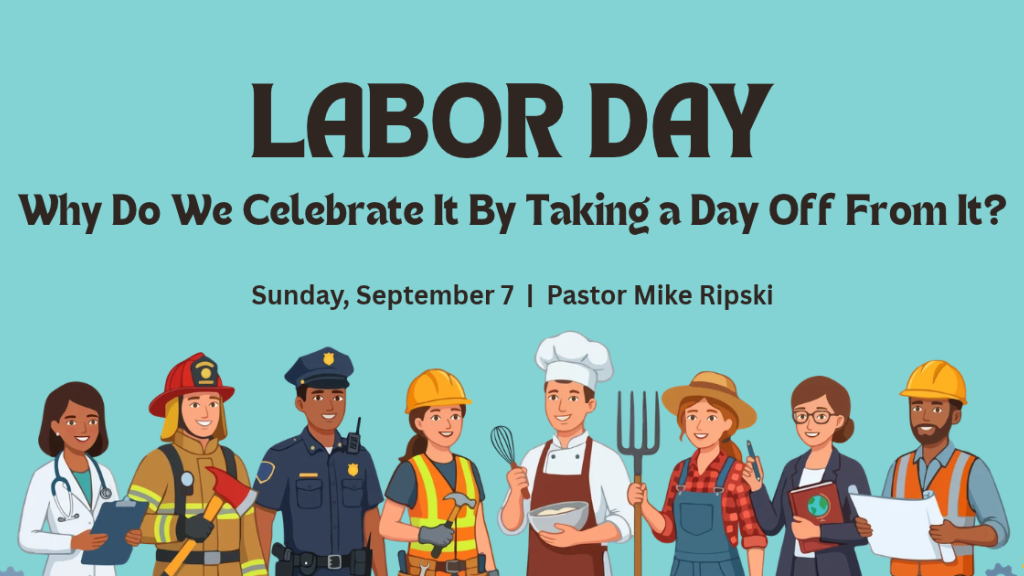
I want you to know how precious you are as the body of Christ in this community to each other, but also to those who, when they're ready, come back home to you. Now, today's topic is labor. Those of us who follow Jesus spend so much time laboring in one way or another, we need to reflect on how that fits into our Christian witness.
We work at what we get paid for, and we work for what we don't get paid for, and that's what makes this so confusing. Have you ever thought, and you all remember a decade ago, that preacher that just had some really weird thoughts. Well, this is another one.
The weird thought that we celebrate, we observe Labor Day, but not doing any labor. If it was worth celebrating when we do more of it rather than none at all, what that does is it points out how work, labor is a mixed bag, isn't it? Is it a blessing? We need to do it. We have to do it. We should do it. We're grateful that we can, and yet we're just as grateful for TGIF and holidays and vacations and time when we don't have to do it. Is it a blessing or a curse? And the answer is yes, and that's what I want us to do this morning, is look at that yes with all of its ambivalence. I'm going to give you three images, visual pictures that I want you to hold in your mind and take with you today. One is around the passage of Scripture that Rebecca read, Jesus's call of James and John. They're working in the boat with their father mending their nets, and Jesus comes by and says, follow me, and they follow him.
And the picture that I imagine, that I'm going to invite you to imagine too, is Zebedee up on a ladder painting over Zebedee and son's fish market, and he's painting over the and sons because they've left the business. And a neighbor says, what are you doing? He says, I'm painting over and sons because my sons are no longer working with me. Why not? Well, this itinerant preacher came through town and said, follow me, and they got out of the boat, and they followed. Well, didn't you try to talk them out of it? That sounds crazy. They've given up their income. I try, but they left anyway. Can you see Zebedee, the father painting over the and sons because Jesus has messed up the business, the family business. When you think of work, what do you think of? If you're like me, you think of people who have met the most of you who probably got paid the least if they got paid anything at all. That's what makes this whole business of labor and work a mixture is that money that apparently reflects or is supposed to reflect value gets all mixed up in it.
I think of my grandmother, my eternal grandmother. She'd get up in the morning, fix breakfast, eggs, bacon, toast for whoever's there. Do you remember the little aluminum chrome containers that had the filter at the top that would catch the remnants of the bacon so that all the grease fell to the bottom? She'd fix breakfast. She'd clean up, then she'd start on lunch, and then she'd clean up, and then she'd start on supper. Everything she fixed during the day, she'd scoop in that grease container and put bacon grease in it. It made no difference what it was, but it was good. Not healthy, but good. That was my grandma. That mother worked at the locker club off the base at the Memphis Naval Air Station in Millington. The locker clubs was where sailors could rent lockers to put stuff that they didn't have room where they lived, could go. She took me one summer with her, as did the custodian who was there, an African-American gentleman who brought his little boy. His little boy and I had a wonderful time.
I think when Jesus said, unless you become as a little child, you can't enter the kingdom of God because children love a playmate and they don't care what color he is, where he's from. Anyway, I got to know him. We were both in elementary school. We were small. This was back in the day of segregated schools, and he told me that when he started school in a few weeks, he would get out again. Anybody know why? Yep, they pick cotton. Little boy gets out of school along with the adults who are the same color he was who would pick cotton. That's part of our history when we think about labor and work. Children have been a part of that.
Another part of the story of our labor is who's been allowed to do what? I remember when women were not permitted to do certain jobs because they weren't strong enough, they weren't stable enough, they weren't smart enough, they weren't whatever enough. And then we came to our senses. And now I have a woman who is my primary care physician and a woman who is my nephrologist.
And when I was in theology school, the first women who were beginning to be prepared for ordination in the United Methodist Church were just coming to theology school to pursue their ordination. And I remember how talented, how gifted these women were, and the Holy Spirit planted this question in my head. Why would God give gifts and talents to women and then tell them they couldn't share them with a church that needed them? It's one of the reasons why the United Methodist Church, before other denominations, decided God wouldn't give gifts and talents the church needed.
When I was preparing for the ministry, I did a summer of, it's called clinical pastor education. Really what I was was an intern chaplain at Grady Hospital in Atlanta. Anybody know Atlanta and know Grady? Grady is a huge welfare hospital. It's also a teaching hospital and residents would come through. And back in those days, they felt like the best way to prepare doctors is to wear them out by overworking them. Sleep insomnia somehow was supposed to be an asset toward making good doctors. They've decided that's not a good thing for our doctors to be asleep when they treat us. But I had a chance to get to know some of the residents. I remember asking one of them, why are you doing this? This seems so hard.
And he said, I want to make a lot of money. I asked another resident, why are you doing this? And he said, I want to help people. Got another image for you. If you've ever attended a small group, you circle up or you're in a center school class and you're around the table and there are different voices discussing a particular topic. I want you to hear some of these biblical voices and what they have to say about labor, about work, and about our life of faith. The second story of creation, when humans decided they knew better than God and could live on their own, faced a consequence. One of the consequences is that women would have babies in pain. What do we call it? We call it labor and women can tell us men a few things about labor. To the man, it was by the sweat of your face you will eat bread.
Again, we want to work. We need to work. We have to work. We look for work. We become distressed and we can't find it. But it won't be easy. We'll pay a price. Moses, 10 commandments, brings down the 10 commandments. Remember the Sabbath day. Treat it as holy. Six days, you'll work. But on the seventh, you'll rest. God did. You not only can, but you need to. But Moses, they need me there. The office can't go on without me. The business will crumble without me. And Moses says to us, trust God to take care of it while you're resting.
God can do it. You're not as necessary and as important as you think you are. The psalmist says, another voice from around the table, unless it is the Lord who builds the house, the builder's work is pointless.
It is pointless that you get up early and stay up late eating bread of hard labor because God gives sleep to those he loves. What we do, somehow we've got to see as God infused. Or else our work is pointless.
All right. Every class, every group has a member that everybody wishes would stay home. This is true of the preacher in Ecclesiastes. Co-helif is what he's called. If you read Ecclesiastes, this is what Ecclesiastes says about work, labor. I refrained from nothing that my eyes desired. I refused my heart no pleasure. Indeed, my heart found pleasure from the results of my hard work. That was the reward from all my hard work. But when I surveyed all that my hands had done and what I had worked so hard to achieve, I realized that it was pointless, a chasing after wind. Nothing is to be gained under the sun. Well, I'm going to take a vote of the rest of us who are in the study.
Can we vote him out because he's awfully depressing. All right, Jesus, it's your turn. What do you have to say to us? And Jesus says, therefore I say to you, don't worry about your life, what you'll eat or what you'll drink or about your body, what you'll wear.
Isn't life more than food and the body more than clothes? Look at the birds in the sky. They don't sow seed or harvest grain or gather crops into barns, yet your heavenly Father feeds them. Aren't you worth much more than they are? Okay, Jesus, as usual, you're the naive one in the group.
And then there's Paul. Okay, Paul. Even when we were with you, we were giving you this command.
If anyone doesn't want to work, they shouldn't eat. Being lazy isn't a virtue. That's a part of this ambivalent mixture, isn't it? And if you go to Corinthians and hear Paul talk about how he viewed that due to his mission and ministry, the churches should financially support him.
He said, we chose not to receive your support because we didn't want you to think we were doing what we were doing for the money. We wanted to be sure that you were clear that what we were doing was due to our call from Jesus to share with you the gospel. Well, as most study groups, the variety of voices gives us something to think about.
How we are to view work, labor. I'm going to leave you with three words to three different segments of the congregation. The first group is a group who may be deciding what they're going to do with their life, what their work is going to be, how they perceive their calling. A Quaker, writer by the name of Parker Palmer, has written a book called Let Your Life Speak. And in that book, he describes how he took a job, Paul Stumm as a university president, and it about killed him because it wasn't who he was, but he thought he had to be. And the longer he tried to be who he wasn't, the more depressed he became.
And if you want to hear a great, read a great description of clinical depression, look him up, Parker Palmer, look at his article. God doesn't call us to do something that doesn't line us up with who he made us, who God has made us. The second group I want to speak to this morning, is those of you who are actively working. You're midlife, you're bringing in the money, you're up in the morning, you drink your coffee, you go to work, you come home. If you come home, work late. What do we call it? We call it workaholism, because work can be an addiction.
We can believe that it can give us what we need when it can't, but we keep at it and we keep at it and we keep at it thinking that eventually it's going to deliver on the promises that it's made us and it makes us sick. And what happens when we get sick, it usually contributes to our making everybody else around us sick, especially those closest to us. The third group that I want to speak to is a group that looks like me and blows out so many candles on our birthdays.
We don't even put candles on the cake because it would catch the house on fire. I ran into Ken Davis at Costco. Ken says, how are you? This is after I'd been retired for a couple of years. And sometimes the Holy Spirit frees us up so that our truth connects with our voice. And I said, Ken, I just feel useless. And that was about the time my wife Karen said to me, I'm sick and tired of you moping around the house depressed, either go see a psychiatrist or find something to do. Get out of here. And I said, okay, I'm going to church. And you all have made me useful again, and I thank you.
The third image, I told you I was going to give you two images. One was Zebedee up on the up on the ladder. The other was the round table of the conversation with the biblical witnesses. This image comes out of Hebrews chapter 12, when reference is made to that great cloud of witnesses who have gone before us, who are cheering us on to be faithful, to run the race, to keep going. Well, I'm going to move that great cloud of witnesses to the stadium here on earth that we are in. Those of us who are older, maybe have a little wisdom, are trying to hear our call as to how God wants to use us in our older age when we're running out of energy. But we have enough energy to cheer on those who have more energy and are running that race. And that race is a relay race. And a relay race is a race in which the baton is passed on.
Those of us who are older can encourage those who are running the race now and not give up despite all the reasons to give up and to hold on to that baton and be sure that they don't lose Jesus in it in his way, even though his way is demanding, risky, can be unpopular, can be sacrificial. That's why those of us cheering on can give encouragement to those who need it. Amen.
Series Information